


In 2019, the Forum for Strategic Studies (FORST) has launched a large annual conference project called Strategic Streams with the intention of discussing the most important strategic event that affects Europe, the Balkans and the world in a given year, with the intention of gathering distinguished experts, diplomats, decision makers, professors, scientists and high-ranking strategists from the country, the region and the world, who would exchange their opinions, insights and ideas at the Strategic Streams conference, once (or more) times a year, about future strategic trends in the 21st century. So far, the conference has been held in 2019, 2020, 2021, 2022, 2023 and 2024.
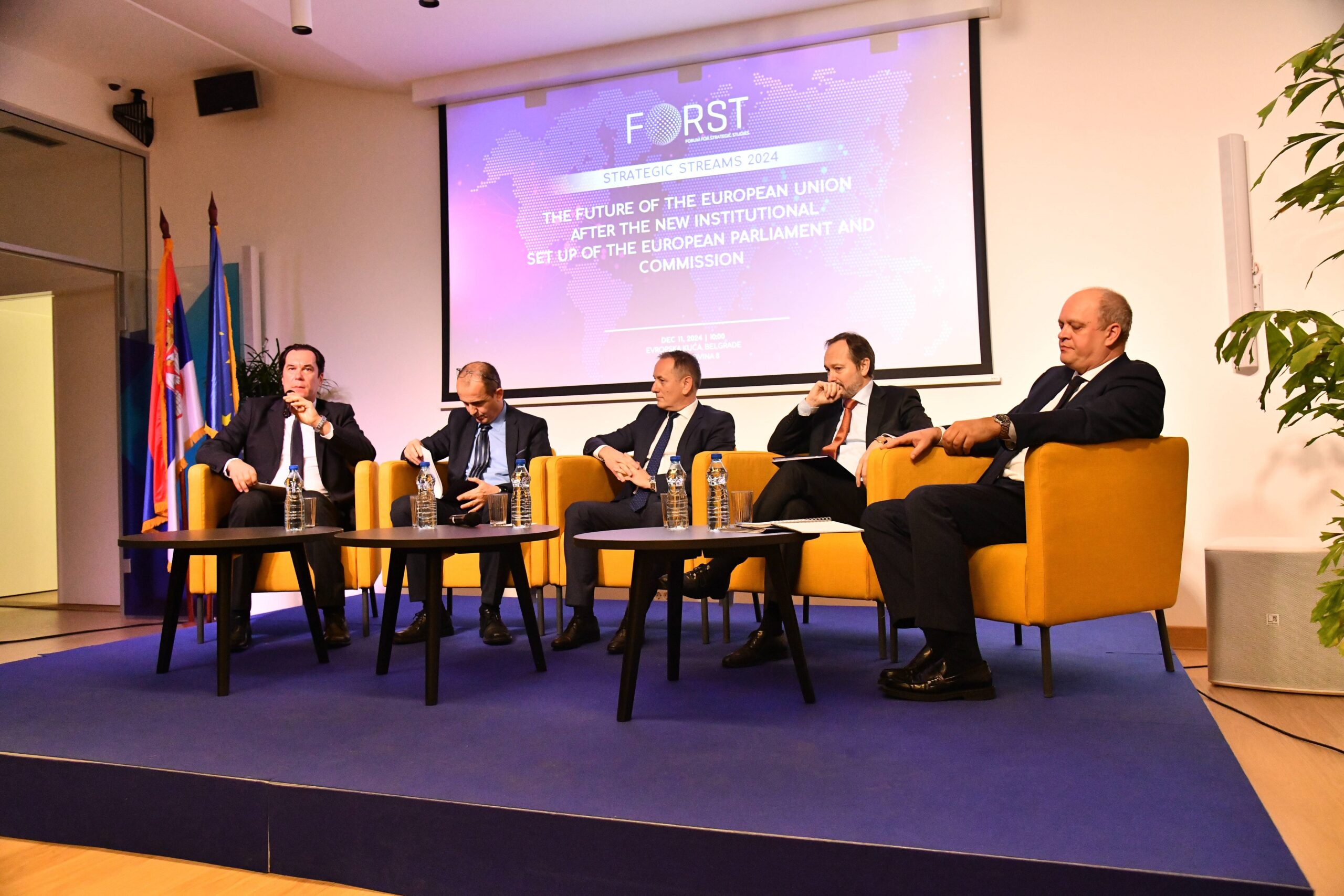
In 2024, the conference was held on December 11 at the European House in Belgrade under the title Strategic Streams 2024: The Future Of The European Union After The New Institutional Set Up Of The European Parliament And Commission. At the conference, high-ranking guests from the European Union, Serbia and the region discussed the future of the European Union after the new institutional composition of the European Parliament and Commission, as well as after changes in the organization of government in the United States of America after the presidential elections held in November 2024.
The conference specifically considered the position of Serbia and the Balkans in the context of these institutional changes, as well as the European Union's capacity for expansion within the framework of the new European and American administrations. In addition, there was a debate about the strategic agenda of the new European administration (2024-2029) and how new strategic factors, such as the new American administration, will affect that agenda, i.e. how will the victory of Donald Trump in the presidential elections affect the administration in Brussels? What changes can we expect in the relations between the EU and the USA after his re-election? What consequences will the protectionist measures of the USA have on the global economy and the position of the European Union? Does Europe need to reduce bureaucracy and what are the challenges facing the administration in Brussels? These are just some of the issues that were considered this year at the Strategic Streams conference, and there was also talk about the geopolitical position of the European Union in the world of accelerated geopolitical changes and how the new European administration can respond to these challenges.
The guests and audience of the conference were members of the diplomatic corps in Serbia, as well as representatives of the cultural, academic and public life of Serbia, who could participate in the discussion by asking questions to the speakers. The conference was followed by media representatives from the country and the region, and it was broadcast directly on the most visited portals of Serbian media space.
At the beginning of the conference, Dr. Neven Cvetićanin, president of the Forum for Strategic Studies (FORST), addressed the attendees and welcomed the attendees, noting that this year’s conference is the sixth conference in a series under the brand Strategic Streams and that this year, as in previous years, the Forum for Strategic Studies managed to gather the diplomatic and strategic elite of the region and Europe to have a qualified discussion about the future of the European Union after this year's institutional changes, especially in light of future institutional changes in the United States, which are undoubtedly the most significant political events in 2024. Dr Cvetićanin noted that in previous years the speakers at the conference were influential strategists from the region and Europe, prime ministers, ministers, negotiators with the EU, directors of some of the most influential European foundations such as the Fridrih Ebert and Konrad Adenauer foundations, as well as associates of some of the most influential European think tanks. He noted that the basic idea of the Forum for Strategic Studies – FORST is precisely to be a platform for the exchange of ideas, concepts and opinions between decision-makers, the diplomatic, academic and business world, in order to jointly debate at a high level about those strategic trends and events that define the future of the region, Europe and the planet.
He presented a brief history of the Forum for Strategic Studies and the annual Strategic Streams conference itself, which is different from other typical conferences on international events because it is not only informative, but also educational, and represents an open platform for interaction and dialogue between different social groups, diplomatic centers and countries, which is lacking in the world we live in, because it is usually divided into narrow groups of like-minded people within homogeneous ideological and geopolitical blocs. The mission of the Strategic Streams conference series is to bring to the same debating table representatives of different ideas about the future of the region, Europe and the world in order to exchange opinions in a credible way.
Dr. Cvetićanin noted that Serbia as a society and state lacks debate between different social groups that are closed in their ideological and ideological bubble, as a result of which society is left without an internal dialogue, without which it cannot develop the full maturity of institutions and embark on the path of development using all social capacities. The idea of the Forum for Strategic Studies is precisely to gather experts from the country, the region and Europe in order to debate on an expert basis the main strategic streams that affect our common future. The mission of the Forum for Strategic Studies is to use an expert approach to reduce political problems to problems of expertise, seeking expert and professional solutions for them.
At the very end of his speech, Dr. Cvetićanin announced the program of this year's conference, which will consist of two large panels and one smaller closing one, whereby the first panel will discuss the impact of the new composition of European institutions on the process of EU enlargement to the Western Balkans, i.e. on those countries that are currently outside full membership in the EU, while the second panel will discuss the consequences of the presidential elections in the USA on strategic trends in Europe and the region. The closing panel will present the conclusions of the conference, which will be followed by a small cocktail for participants and guests of the conference.
After Dr. Cvetićanin’s introductory speech and the opening of the conference, the first panel began, entitled The New Composition of Institutions of European Union and Enlargement to the Western Balkans. The first speaker on this panel was the Head of the Delegation of the European Union in Serbia, Ambassador Emanuele Giaufret, who, when asked about the ideal timing for EU enlargement, said: “The moment is now. The time is now!”, apostrophizing that the subject of EU enlargement has once again become the focus of interest of the umbrella institutions of the European Union as well as its key institutional leaders.
“We need to make the EU not only bigger, but also stronger. We need to know that the new member is competitive in the single market and empowered to contribute to the EU,” said Ambassador Giaufret, adding that expansion is a geopolitical imperative, and that the war in Ukraine served as a sort of trigger for that.
Serbia’s geostrategic goal is to complete preparations for membership by the end of 2026, said Giaufret and added that it is very ambitious, but also achievable. He added that many countries within the EU have decided to open the issue of enlargement the EU to the East, as well as that in the meantime the efforts of the EU institutions regarding the Western Balkans and related to the Western Balkans have become visible, such as the creation of the Growth Plan for the Western Balkans, and added that the bloc itself is working on its own, internal reforms.
“It is achievable if we invest all the necessary resources and efforts. The growth plan and the reform agenda are certainly a useful tool because they are time- bound and provide a financial incentive. We must expand to make the EU bigger, but also stronger. That is why we have reforms to make sure that the country that will join will be ready to contribute to the Union, but also to be competitive on the single market,” stated Giaufret.
He said that, in his opinion, Cluster 3 was technically ready for opening in 2021, but that Serbia accepted the methodology according to which progress depends on negotiations with Pristina and reforms in the rule of law. He said that he cannot say with certainty when the Cluster will be opened, that it may be during the Hungarian presidency, and maybe when Poland takes over the presidency.
Ambassador Giaufret said that the Western Balkans and Serbia are not and cannot be forgotten by the administration in Brussels, because they are politically relevant. In this sense, politically relevant steps have been taken for the continuation of the integration of the region and Serbia into the European Union, which not only concern the Growth Plan and the payment of funds within it, but also the continuation of the integration of the region and Serbia into the single market of the European Union so that the citizens of the Western Balkans can benefit from the accession process even before the full membership of their countries in the European Union. The European Union does not just keep talking, but has a series of actions to bring the region closer to itself, as evidenced by the progress in the negotiations of the countries of the region on joining the European Union, the opening of negotiations with Albania, the progress of negotiations with Montenegro, as well as the expectation of the opening of Cluster 3 with Serbia.
In order to achieve the previous goals and be able to devote to enlargement, the European Union is also dedicated to its internal reforms on which the European Council will have a meeting about in June 2025, and the commitment to enlargement is evidenced by the fact that Commissioner Marta Kos was appointed to the new commission, whose sole portfolio and task will be enlargement, which is a good sign that this process will not be forgotten.
Finally, Ambassador Giaufret said that he expects one or two countries from the region to become full members of the European Union by the end of the mandate of the new Commission in 2029, which is a geopolitical imperative, and in this sense the European Union is helping to accelerate reforms in Serbia.
After Ambassador Giaufret’s speech, the second speaker on the first panel was Acting Assistant to the Minister of Foreign Affairs of the Republic of Serbia, Ambassador Miloš Todorović, who said at the beginning of his speech that there is no doubt that joining Serbia to full membership in the European Union is the country’s strategic goal, and there is no other plan, as is often unofficially speculated.
Ambassador Todorović said that Serbia is making significant efforts to meet the criteria for opening Cluster 3 and pointed out that it is important for Serbia to join the common market of the European Union because it feels that it is competitive in it. Ambassador Todorović said that Serbia’s economy is larger than all other economies of the region combined and that Serbia’s exports to the European Union represent more than fifty percent of the region’s exports to the Union. Ambassador Todorović said that Serbia respects all its neighbors, but that without Serbia, given its size and position, the process of expanding the European Union to the region would remain questionable.
Ambassador Todorović finally concluded that after a long time in which enlargement was not high on the agenda of the European institutions, the European Union’s enthusiasm for enlargement has again been felt in the last couple of years, which is caused by geopolitical reasons, of which Serbia is aware, and that therefore it wants to fulfill its obligations in the negotiation process as soon as possible, in order to catch the current renewed momentum of enlargement and get closer to the European Union as possible. Ambassador Todorović finished his presentation by emphasizing that he is currently much more optimistic than he was earlier because it seems to him that EU enlargement to the Western Balkans is back on the agenda and that it is currently a two-way street, not a one-way street as it was until recently.
After Ambassador Todorović’s presentation, the third speaker on the first panel was the Ambassador of the Republic of Hungary in Belgrade, Jozsef Magyar, in his capacity as the ambassador of the country that presides over the European Council at the time of the conference, which made the conference able to bring together, formally or informally, representatives of all the institutions of the European Union, which gives the conference a special significance and weight. At the beginning of his presentation, Ambassador Magyar pointed out that Hungary’s presidency of the European Council was transitional, with his country’s clear desire to bridge the gap towards candidate countries such as the countries of the Western Balkans in order for them to speed up negotiations with the EU, and he especially pointed out Serbia as a country that has been repeatedly emphasized in European institutions as being ready to continue negotiations with the EU.
The Hungarian ambassador also announced the soon holding of a summit of the European Union in its new set of institutions, primarily the European Commission, and the countries of the Western Balkans, in order to recognize and further encourage the visible progress of certain countries in the negotiations, highlighting Albania in particular as the country that made the most progress in the negotiations during the Hungarian presidency. He pointed out that the negotiation process is not only with the candidate countries, but also with the member countries in order to convince them to support the enlargement process, and the task of the annual reports of the European institutions on the progress of individual candidate countries is precisely the function of presenting to the member countries objective reasons why someone should be supported on the path to joining the European Union.
In this sense, the question is how can Serbia be helped to open Cluster 3, for which it has actually met the technical conditions, and given that the chapters in this Cluster are not close to the issues of the European Union’s foreign and security policy, Serbia’s progress in this Cluster can be evaluated independently of other issues that could prevent its opening. The Hungarian ambassador pointed out that as far as Cluster 3 is concerned, Serbia has done a really serious job of adapting to European standards and that it must be rewarded for that in a way that will appreciate its efforts.
Ambassador Magyar concluded his presentation by noting that the European institutions, regardless of whether it is the European Commission or the European Council, are aware of the efforts made by Serbia in preparing Cluster 3 for opening, but that the question is whether the member countries have the same opinion, which can slow down the process of opening this Cluster and in general the continuation of negotiations for political reasons, considering their own political priorities.
After the Hungarian ambassador’s speech, the fourth speaker on the first panel was Dr. Zlatko Šabić, adviser to the Slovenian president Nataša Pirc Musar, who noted at the beginning of his speech that he was speaking at the conference in his personal capacity, and that his views should not be understood as the views of the Slovenian president or the government. Therefore, in a somewhat freer manner, he noted that the position of the European Commission on the necessity of expanding the EU to the Western Balkans must be taken seriously, because Europe simply has no other choice, since in the existing geopolitical circumstances it will be vulnerable as long as it does not round itself off and receive this “soft belly” of its own in the Balkans.
Therefore, it is a significant task before the European institutions and before the candidate countries and member countries to properly understand the moment and not to be individually selfish, but to look at the higher interest of the European Union for expansion, without which the European Union cannot compete with superpowers such as China or the United States in the economic sense, and especially not in the technical and technological sense, since especially in this second sense it lags behind and is not even among the first few world powers.
Dr. Šabić continued that as far as Slovenia is concerned, it is well known that strongly supports the process of expanding the European Union to the region, and that played a special role in supporting the acquisition of candidate status and the opening of negotiations with Bosnia and Herzegovina, but that Slovenia does not want to teach anyone what to do in order to meet EU standards, but has shown by its example that it looks at the bigger picture, not only its own narrow national interests, in order to help the homogeneity of the European Union. It paid off for Slovenia because, since joining 20 years ago, increased its GDP multiple times and realized that Croatia would also become a member after it, and resolved open issues with Croatia within the EU system, and practice shows that it is always easier to resolve mutual issues when two countries are together within the EU system.
Dr. Šabić concluded that the enlargement process must be meritocratic without abuse of the veto of individual states for political reasons, which is why he personally, as well as a significant part of the people in Slovenia, is in favor of introducing decision-making by a qualified majority, and not by consensus regarding the issue of enlargement.
After Dr. Šabić’s speech, the fifth and last speaker on the first panel was Matjaž Nemec, a member of the European Parliament from Slovenia, who joined the discussion online via the Zoom platform, expressing his regret that he could not join the conference by being present in Belgrade, but that he considers the topic and speakers of the conference to be very important and that is why he is participating directly from the European Parliament via Zoom.
MEP Nemec said that we need new energy and a new vision for joining the Western Balkans to the European Union, because enlargement is again at the top of the EU agenda due to geopolitical reasons. However, he pointed out that the European Parliament turned to the right after the last EU elections and that there is a new atmosphere and division in it no longer between left and right, but between pro-European and anti-European forces in terms of support for current and existing EU institutions, which will certainly affect the EU enlargement process. However, he also pointed out that with the appointment of Marta Kos as European Commissioner for Enlargement, new energy can be felt in the EU institutions regarding enlargement and that she is aware that she has to dissuade skeptical member states and groups in the European Parliament regarding further EU enlargement.
After the presentation by MEP Matjaž Nemec, the moderator of the first panel, Dr. Cvetićanin, asked all panel participants the same question – to state their assessment of when Cluster 3 could be opened in the accession negotiations between Serbia and the EU, as well as their assessment of which countries of the Western Balkans will eventually be admitted to full membership of the European Union by the end of the mandate of the new European institutions, i.e. by 2029. The majority of the speakers of the first panel replied that Cluster 3 has long been ready for opening in a technical sense, but that its opening depends on the assessment of how far Serbia has progressed not only formally, but also substantially in reforms. Ambassador Giaufret specifically pointed out that Cluster 3 is ready for opening from 2021, but that there are “two hats” that decide on the opening – one is the European Commission, and the other is the member states, and that the Commission would probably approve the opening of that Cluster, but that certain member states need to be convinced that the reforms in Serbia are essential and not just formal, and that it is therefore difficult to say more precisely when Cluster 3 will be opened, which ended the presentations of the panelists in a realistic manner.
After all the speeches of the panelists, several questions from the audience were asked by representatives of the private sector and international chambers of commerce, as well as by representatives of the media and representatives of state institutions in Serbia, all of which concerned the better optimization of the process of Serbia's accession to the European Union, about which the panelists gave their final speech and once again underlined that the negotiation process is complicated because it involves candidate countries, European institutions and member states, whose composition creates the institutional package of opening and closing chapters and clusters that is realistic and enforceable at a certain moment.
The second panel of the conference entitled The New Composition of Institutions of European Union and New USA Administration – European Strategic Agenda 2024-2029 in the New Circumstances was moderated by Ambassador Dr. Duško Lopandić, president of the Forum for International Relations of the European Movement in Serbia, and this panel discussed the relations between the European Union and the United States of America with regard to the elections held in America and the EU and the new institutional composition that will be led by the two parties, but also about the continuation of the EU enlargement process in the new institutional context.
The first speaker on the second panel was Elvira Kovač, President of the Committee for European Integration of the National Assembly of the Republic of Serbia, who at the beginning of her presentation spoke about the cooperation between the National Assembly of the Republic of Serbia and the European Parliament through the mixed Association and Stabilization Committee made up of representatives of the Serbian and European Parliaments.
MP Kovač also spoke about the discussions within the Serbian Parliament and especially the Committee for European Integration with Serbian state and European institutions on optimizing the process of joining Serbia to the European Union and about the meetings that Serbian parliamentary officials had with European ones, such as the recent meeting between the president of the Serbian and European parliaments, and she announced some more meetings in that direction.
The second speaker on this panel was Pierre Cochard, Ambassador of the Republic of France to Serbia, who began his presentation by stating that the new composition of the European institutions, both the European Parliament and the Commission, is actually a composition of continuity compared to the previous institutional compositions of the EU, but that in this context it is really a challenge how this composition of continuity will cooperate with the new American administration because it seems that there is discontinuity and certain social instability in America.
In facing this challenge, the European Union, in the opinion of Ambassador Cochard, must be realistic and should have no illusions about the new Trump administration and the fact that Trump does not like the EU because of its values, primarily because of the values of multilateralism and regulation. In this sense, the EU must prepare for very difficult and complicated discussions with America, which, despite everything, remains the main ally of the European Union. Discussions will be conducted around three basic issues – the concept of European security including the approach to the war in Ukraine, then the issues of mutual trade and tariffs, and, finally, issues of global challenges such as global warming and the climate agenda.
Ambassador Cochard said that the EU, unlike the new Trump administration, has similar attitudes with some countries of the global south such as India and Brazil, especially with regard to the climate agenda, but also a strong partnership with Canada and Japan, being closer to them than the Trump administration, concluding his presentation that the EU has capacities and elements in its strategic agenda until 2029, which, if implemented, can lead to a more united and stronger EU by the end of the mandate of the current European institutions.
The third speaker on this panel was Luca Gori, Ambassador of the Republic of Italy to Serbia, who at the beginning of his speech pointed out that Italy has always been sincerely in favor of the expansion of the European Union to the Western Balkans and that is why it is in favor of opening Cluster 3 in the negotiations with Serbia, especially now that we have a new momentum starting the enlargement process, and that is the war in Ukraine, as a result of which the geopolitical moment becomes crucial in the enlargement process. Therefore, we need to look at the EU enlargement process in the new context of the formation of a new European security architecture, and especially in the context of the formation of a common European defense and the reduction of Europe’s dependence on other major powers for critical raw materials.
In the opinion of Ambassador Gori, the re-election of Trump as President of the United States is actually a kind of wake-up call for Europe, which has to deal with it if it wants to develop its own strategic autonomy, in which a particularly important factor is the reduction of the technological gap between Europe and the USA and China, in the sense that the EU is not technologically far behind these powers. The EU also needs to improve its competitiveness on world markets, and in this context, Ambassador Gori mentioned the report given by Mario Draghi, the former President of the European Central Bank, in which it was specified how much the EU needs to invest in raising its own competitiveness.
The fourth speaker on this panel was Dr. Stiven Blockmans, Senior Associate at the Center for European Policy Studies, one of the leading European think tanks, who joined the conference from Brussels via the Zoom platform. At the beginning of his presentation, he looked at EU-US relations in the context of the new personnel composition of the institutions and noted that the second term of the Donald Trump administration will be different from the first because the new American administration will now really begin to smoothly implement its nativist, libertarian and isolationist agenda compared to the first term when they did not have the necessary experience to do it, what they have now, and for them works that even the administration of President Biden has retained some of the policies of the first Trump administration and what seems to be this a strategic rather than a tactical shift by the United States.
In this sense, Dr. Blockmans noted that the agenda of the new Trump administration is opposed to the European strategic agenda 2025-2029. However, Dr. Blockmans believes that Europe is not on the front line with the new Trump administration, it is primarily China, and that Europe can be collateral damage in this fight between the two sides, primarily as regards the introduction of protectionist tariffs by the USA to Europe, because the European economy and market are much more vulnerable than the Chinese one.
Regarding the eventual withdrawal of America from NATO, Dr. Blokmans estimated that Trump will not go too far in this regard and that his main goal is to raise the percentage of allocations for the defense of other countries in NATO. However, despite the fact that Trump will not go too far in this, Europe needs to develop its strategic autonomy and implement its Strategic Agenda 2025-2029. to be ready for all challenges.
The fifth speaker on this panel was Prof. Dr. Predrag Bjelić, full professor at the Faculty of Economics in Belgrade and an internationally recognized expert on global trade. He spoke about the position of the World Trade Organization (WTO), which was powerless in the face of the protectionist measures of the first Trump administration, underlining that the very structure of the WTO has changed since the admission of Russia and China, where China now has more influence within the organization than the USA, which is turning to protectionism. Professor Bjelić emphasized that not only the first Trump administration turned to protectionism, but the Biden administration continued similar policies, which is just a prelude to the real expansion of protectionist measures during the second Trump administration, which will probably not be applied only against some countries like China, but against a whole series of countries.
In all of this, in the opinion of Professor Bjelić, Serbia can also be put in an uncomfortable position, and it is precisely for economic and trade reasons that it is important, in his opinion, that the process of enlargement of the European Union continues and that Serbia goes in that direction, as this enables better protection from various protectionist measures. Professor Bjelić also believes that it is important for the EU itself to develop economic and trade relations with China as a counterweight to possible Trump tariffs on European products, and that in this sense the EU and China should make a certain strategic compromise that will have positive economic effects on various European countries.
In the opinion of prof. Bjelić, the EU lags behind China and the USA in the agility of its economic measures and is generally in the uncomfortable position of suffering trade pressure from both sides, as a result of which the European Union needs a more strategic way of thinking, and less of a bureaucratic one. Serbia also needs a more strategic way of thinking and insight that, for example, it is not interesting for China in itself, but as a potential future member of the European Union, through which China gains access to European markets, as evidenced by the fact that China is more interested in the countries of Central Europe that are members of the EU than in the Western Balkans, which is still awaiting admission.
The speech of prof. Bjelic was followed by questions from the audience to the panelists, and a fruitful discussion ensued that covered a number of topics – from the specific political situation that conditions the work of the Serbian Assembly on the implementation of European legislation, to the situation in Syria, i.e. in the Middle East, i.e. Ukraine as an indicator of geopolitical trends and the balance of power between the great powers. Ambassador Gori concluded this panel with the statement that “history has returned” even though its end was declared and that we mistakenly thought that we could only deal with topics such as the economy, digital transformation and the green agenda, and that Europe will again have to deal with historical topics such as conflicts, migrations and the relationship between different ethnic groups if it wants to act as a geopolitical actor.
The second panel was followed by the final panel of the conference with three speakers whose task was to summarize the main theses of the conference and turn them into concrete conclusions that can serve public policies dealing with the process of enlargement of the European Union and the harmonization of standards and legislation between Serbia/the countries of the Western Balkans and the European Union.
The first speaker at this closing panel was Damjan Bergant, Ambassador of the Republic of Slovenia to Serbia and representative of the Embassy that was the main organizing partner of this year’s Strategic Streams 2024 conference. At the beginning of his presentation, he said that the discussion on both panels of the conference was very good, even exceptional, and that the conclusions of the conference were usable and that a lot could be learned about the continuation of the EU enlargement process from the discussion so far. He emphasized that Slovenia has always been, is and hopes to always be a supporter of EU enlargement, especially to the Western Balkans, and thanked all the conference speakers who contributed to this topic through quality discussions.
Ambassador Bergant emphasized that the conference showed the importance of the new institutional composition of the EU in the context of geopolitical shifts, economic insecurities and social transformations, to which the EU needs to respond firmly and with a new vision. He concluded his presentation by stating that now is the time to turn words into actions and to try to implement everything we heard at the conference on the continued expansion of the European Union to the Western Balkans, finally thanking the Forum for Strategic Studies for the initiative to organize the conference on this topic.
The second speaker at the closing panel was Dr. Duško Lopandić, president of the Forum for International Relations of the European Movement in Serbia and a retired ambassador, who began his presentation by stating that the discussions at the conference were exceptional and that they touched the most important topics related to the new composition of the institutions of the European Union. He emphasized that the just held European elections continued to allow centrist groups to maintain their supremacy in the EU institutions, but that it must be realistically recognized that in those elections the EU turned to the right, so for the first time in history we have a vice-president of the European Commission from the ranks of the extreme right who is nevertheless pro-European, which led to strategic cooperation between the center and the extreme right, which marks the internal politics of various EU countries such as Austria and Sweden, and we will only see the capacities of this strategic cooperation in the future.
Ambassador Lopandić then pointed out that it was important that the conference emphasized the new momentum regarding EU enlargement that had been created again, but he emphasized that the "elephant in the room" is the fact that there is still no consensus between EU members on the pace and extent of further enlargement, but also on things such as the EU budget for the period 2029-2034, on which negotiations are starting, and that the EU countries have not yet agreed on the reform of the way of decision-making by majority instead of consensus and on whether each member state will continue to have its own commissioner or some of them will give up.
Ambassador Lopandić ended his presentation by stating that the EU has unfinished business in the Western Balkans and that it is a question of realistic intentions regarding the necessary reforms that should be carried out by the government of Serbia in order to advance the process of negotiations with the EU, because we have been sleeping in this sense for the last 10 years. He emphasized that it is important to have a consensus and dialogue within Serbian society about these necessary reforms needed for the progress of negotiations with the EU. He concluded that the current approach of the EU to the expansion of one country at a time leads to the possibility that an institutional hole will remain in the Western Balkans if, for example, Serbia or Bosnia and Herzegovina do not join the full membership of the EU, but that, unfortunately, it is not realistic for this approach to be replaced by an approach in which all the countries of the region would be admitted to the EU at the same time.
The final speaker of this closing panel and the entire conference was Dr. Neven Cvetićanin, president of the Forum for Strategic Studies (FORST), who at the beginning of his presentation thanked all the conference speakers and guests in the audience for their participation. He concluded that the conference had two different panels – the first optimistic one, which concerned the continuation of the European Union enlargement process, and the second realistic one, which considered geopolitical relations in the world in a realistic way, and that this combination of optimism and realism is exactly what the Forum for Strategic Studies is trying to achieve – that things move forward, but in a realistic, not unrealistic manner. At the end of his final speech, Dr. Cvetićanin thanked the team of the Forum for Strategic Studies, which is responsible for organizing the conference, and presented it to the audience as a unique combination of young people, students and volunteers with experienced diplomats who are members of the Forum for Strategic Studies, which is thus a productive combination of youth and experience.